Last reviewed: October 7, 2026 · OG Cannabis, 469 Dundas St W
Pink Kush is an indica-leaning Kush strain known for three things: a sweet, floral smell often compared to vanilla or rose, bright green buds with pink or orange hairs, and a heavy, body-first effect that most people save for the evening. It is one of the best-known names in Canadian cannabis, sold by licensed producers and unlicensed shops alike.
That popularity is also the catch. A strain name is a label, not a guarantee. Two jars marked Pink Kush from two growers can smell, look and feel noticeably different, and genetic testing backs that up (more on that below).
This guide covers where Pink Kush comes from, what it is usually like, how to check a lot before you buy, and how it compares with the other pink-named strains on our shelf.
Pink Kush at a glance
- Type: indica-leaning hybrid, descended from OG Kush
- THC: typically reported around 19 to 21%; the jar label for your lot is what counts
- Aroma: sweet, floral, vanilla and candy notes over an earthy Kush base
- Common terpenes: myrcene, then limonene and caryophyllene
- Reported effects: relaxed, body-heavy, hungry, sleepy
- Reported downsides: dry mouth, dry eyes, occasional anxiety or flatness
Sources: Leafly strain profile; lab results vary by grower and batch.
Where Pink Kush comes from
Pink Kush is widely described as an OG Kush descendant that rose to fame in British Columbia in the early 2000s. Leafly lists OG Kush as its parent, and it has since been bred into newer strains such as Pink Gelato and Pink Acai.
Here is the honest part. Beyond “OG Kush, then BC,” the record is thin. There is no published breeder’s pedigree, no registered release date, and no lab archive tracing today’s Pink Kush back to a single original plant. Most of what circulates online repeats the same few lines. We would rather tell you that than invent a backstory.
Why the name alone does not settle it
Cannabis names are not regulated the way wine appellations are. A grower can call a plant Pink Kush because of where the cutting came from, how it smells, or simply because the name sells. Research shows how loose that gets:
- Same name, different plant. Anna Schwabe and Melissa McGlaughlin genetically tested 122 samples of 30 strains bought from dispensaries in three US states. Only 4 of the 30 strains (13%) were genetically consistent across every sample. Even “clone-only” strains, which should be identical copies, showed at least one sample that differed (Journal of Cannabis Research, 2019).
- Indica and sativa labels are rough guides. A 2021 Nature Plants study of 297 samples by Canadian and Dutch researchers concluded the indica–sativa scale “poorly captures overall genomic and metabolomic variation.” Labels seem to track a handful of aroma compounds (terpenes) more than genetics.
Neither study tested Pink Kush specifically, and the first used US samples. The lesson still applies: judge the lot in front of you, not the name on the jar. That is what the next section is for.
What good Pink Kush looks, smells and feels like
A good lot of Pink Kush should smell sweet and floral before you open the bag fully, look dense and frosty, and break apart springy rather than dusty. Those three checks tell you more than any THC number.
Look
- Dense, compact buds with the tight structure typical of Kush plants.
- Pink, orange or rust-coloured hairs (pistils) against bright green. The colour varies by grower and harvest timing, so do not treat “more pink” as “better.”
- Heavy frost. The white crystal coating is trichomes, where most THC and terpenes sit. Patchy frost or bald spots usually mean rough handling.
- A clean trim. Leaf stuck to the bud adds weight and harshness, not value.
Smell
Leafly reviewers describe Pink Kush as sweet vanilla and candy over an earthy, floral base, with a rose note. Myrcene is usually the lead terpene, followed by limonene and caryophyllene. If a jar smells like hay or nothing at all, the terpenes have faded with age or poor drying, whatever the label says.
Feel
Break a small bud. It should snap slightly and spring back, not crumble to powder (too dry) or squash flat (too wet, a mould risk).
Effects people report
Pink Kush is a body-first strain. Users in Leafly’s reviews most often report feeling relaxed, sleepy and hungry, with some euphoria and a tingly body feel. The downsides people mention are dry mouth, dry eyes and, for some, anxiety or a flat, unmotivated feeling.
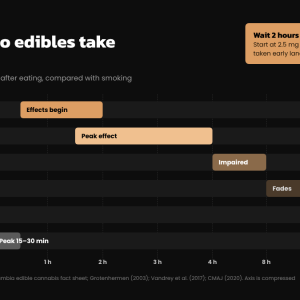
Treat those as patterns, not promises. Effects depend on the lot, your dose, your tolerance and your setting. If you are new to heavy indica-leaning flower, start with one or two small puffs and wait 15 minutes. Smoked cannabis peaks within about 15 to 30 minutes, much faster than edibles (see how long edibles take to kick in).
The pink family on our shelf
Pink Kush has been crossed into a whole family of pink-named strains. They share the name, but they are not interchangeable. Here is how the ones we carry compare.
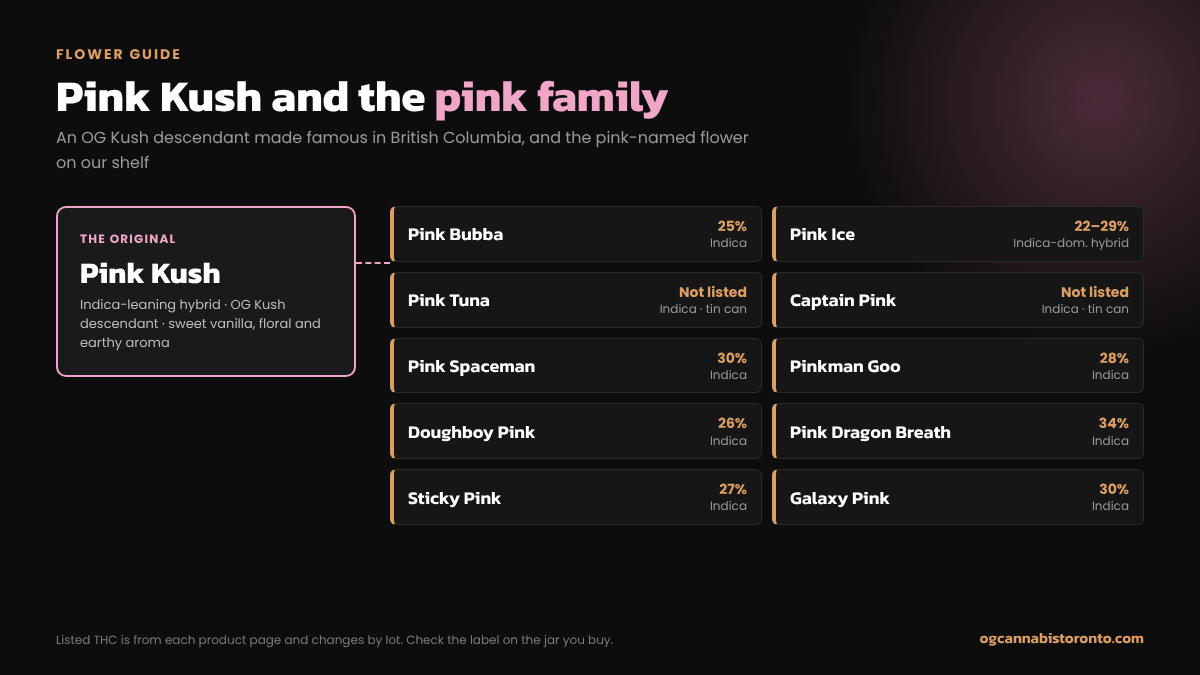
| Strain | Grade / format | Leans | Lineage (as stated on product page) | Aroma (as stated on product page) | Listed THC |
|---|---|---|---|---|---|
| Pink Kush | Not stocked as flower right now | Indica-leaning hybrid | OG Kush descendant | Sweet vanilla, floral, earthy | Lot label |
| Pink Bubba | AAAA+ | Indica | Believed to combine Pink Kush and Bubba Kush | Earthy Kush with sweet floral undertones | 25% |
| Pink Ice | AA, 14 g | Indica-dominant hybrid | Pink Kush × Ice | Sweet florals, damp earth, fuel | 22 to 29% |
| Pink Tuna | AAAA tin can, 7 g | Indica | Pink Kush × Tuna Kush | Pungent skunk and gas | Not listed |
| Captain Pink | AAAA tin can, 7 g | Indica | Believed to descend from Pink Kush | Sweet, floral, strong earthy base | Not listed |
| Pink Spaceman | AAAA+ | Indica | Not listed | Gas and earthy Kush | 30% |
| Pinkman Goo | AAAA+ | Indica | Not listed | Sweet, doughy | 28% |
| Doughboy Pink | AAAA+ | Indica | Not listed | Sweet pastry with earthy Kush | 26% |
| Pink Dragon Breath | AAAA+ | Indica | Not listed | Pungent | 34% |
| Sticky Pink | AAAA+ | Indica | Not listed | Sweet gas | 27% |
| Galaxy Pink | AAAA+ | Indica | Inspired by Pink Kush lineage | Sweet gas, earthy | 30% |
THC figures are the ones listed on each product page and change with each batch; check the label on the jar you buy. Pink Kush itself is on the shelf right now as a shatter and a vape cartridge rather than as flower. Listings checked October 7, 2026.
If you want to compare all of them in one place, see our pink strains collection. The guide below explains how to choose between them.
How to choose a pink strain
Pick a pink strain by smell and by when you plan to use it, not by THC percentage. Here is how we would steer you at the counter.
- Smell first. If you can, smell two pink strains side by side. The one you like the smell of is usually the one you will enjoy. Aroma tracks the terpenes, and the Nature Plants research suggests terpenes drive much of what people experience as “indica” or “sativa.”
- Match it to the time of day. Classic Pink Kush and other heavy Kush crosses suit evenings. Lighter, fruitier pink crosses can work earlier, but test them at home first.
- Do not chase the highest number. A 27% lot that has lost its smell can feel flatter than a fresh 19% lot. THC percentage measures one compound; it does not measure freshness, terpenes or how it was dried.
- Buy small the first time. Try an eighth (3.5 g) before committing to a half-ounce of anything new.
- Ask what changed. If a strain you liked last month feels different, it may be a different grower or batch under the same name. That is normal, and worth asking about.
A note on grades and THC labels
Flower sold outside the licensed system is not tested to Health Canada’s standards, and grades like AAA or AAAA are not regulated terms. They describe a seller’s own judgment of look, smell and potency. That does not make them meaningless, but it does mean your own nose and eyes are the most reliable test you have. We will cover grading in detail in a separate guide to what AAAA actually means.
Picking up pink strains at 469 Dundas
OG Cannabis is a pickup counter at 469 Dundas St W, one block east of Spadina, open 10 AM to 9 PM. You can order online and collect, or ask at the counter to see and smell two pink strains side by side before you choose. We are happy to open a jar.
Ordering takes three steps, laid out in how to order. Payment and ID questions are answered on our FAQ, and the rest of the shop is on the homepage.
Pink Kush questions
Is Pink Kush an indica or a sativa?
Pink Kush is usually sold as an indica-leaning hybrid descended from OG Kush. Treat the label as a rough guide: a 2021 Nature Plants study found indica and sativa labels poorly match plant genetics and mostly track a few aroma compounds. Its heavy, body-first effect is what most people notice.
What does Pink Kush smell like?
Pink Kush typically smells sweet and floral, often described as vanilla, candy or rose over an earthy Kush base. Myrcene is usually the lead terpene, with limonene and caryophyllene behind it. A jar that smells like hay or very little has likely lost terpenes to age or poor drying.
How strong is Pink Kush?
Pink Kush is commonly reported at around 19 to 21% THC, with some lots higher. Strength varies by grower and batch, so check the label for the specific lot. Freshness and terpene content affect how strong it feels as much as the THC percentage does.
Is all Pink Kush the same?
No. Strain names are not regulated, and genetic testing has found products sold under the same name can differ. In one study of 30 strains, only 4 were genetically consistent across every sample. Smell, look and feel are better guides than the name alone.
Why are the hairs on Pink Kush pink?
The pink or orange hairs are pistils, part of the female flower. Their colour varies with genetics and how mature the plant was at harvest. More pink does not mean more potent. Frost, smell and a clean dry are better signs of a good lot.
Sources
- Leafly, Pink Kush strain profile (lineage, reported THC, terpenes, user-reported effects).
- Schwabe A.L. and McGlaughlin M.E., Genetic tools weed out misconceptions of strain reliability in Cannabis sativa, Journal of Cannabis Research, 2019.
- Watts S. et al., Cannabis labelling is associated with genetic variation in terpene synthase genes, Nature Plants, 2021.
A note on sources: Leafly is a commercial strain database built partly on user reviews. It is the best available record for this strain’s reported traits, which is why this guide frames effects as “people report” rather than fact. No peer-reviewed study has tested Pink Kush by name.