Last reviewed: October 6, 2026 · OG Cannabis, 469 Dundas St W
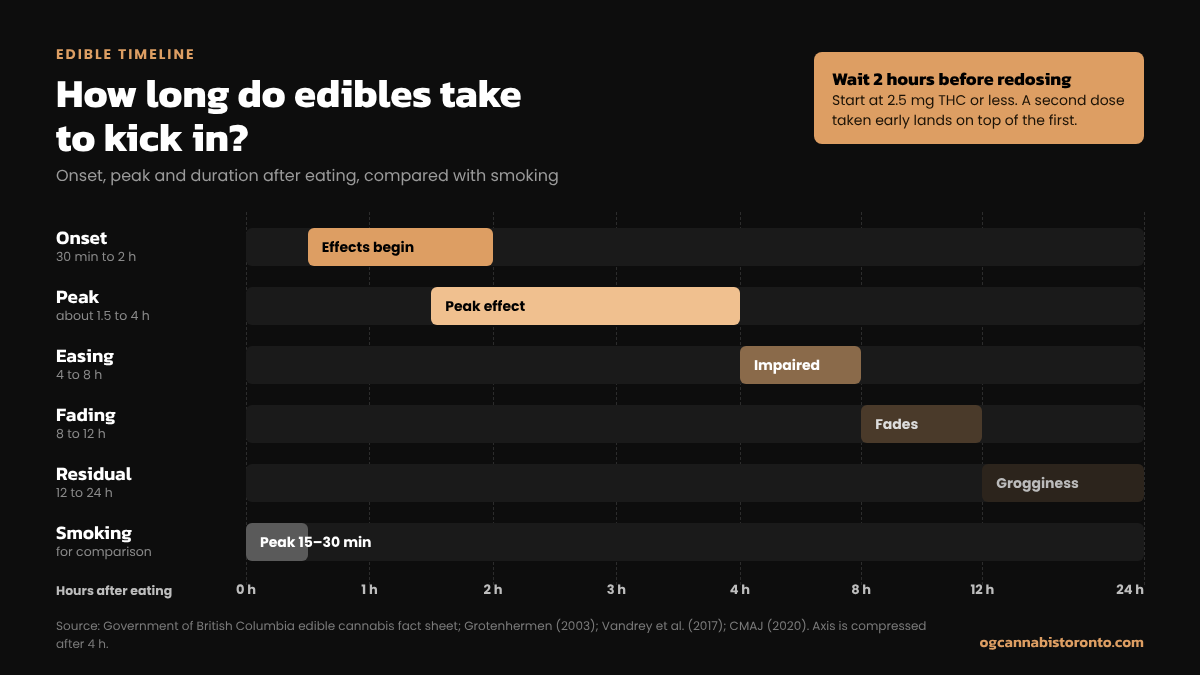
How long do edibles take to kick in? For most people, somewhere between 30 minutes and 2 hours, with the full effect arriving up to 4 hours after eating. That is the Government of British Columbia’s figure. The part that catches people out is the other end: intoxication can run up to 12 hours, and some people still feel it the next day.
That gap between eating and feeling is where almost every bad edible night starts. Somebody feels nothing at the 45-minute mark, decides the gummy was weak, and eats another. Both doses then land together.
This guide lays out the timeline hour by hour, explains why edibles are so much slower than smoking, and covers what speeds them up or slows them down. It finishes with what to do if you took too much.
The short answer
- Onset: 30 minutes to 2 hours. Some people feel nothing for longer.
- Peak: usually 2 to 4 hours after eating.
- Duration: up to 12 hours of intoxication, with residual effects up to 24 hours.
- Starting dose: 2.5 mg THC or less.
- Redosing: wait at least 2 hours before a second 2.5 mg dose.
Source: Government of British Columbia, edible cannabis safe use fact sheet.
Here is why the numbers look like that, and why your own night might not match them.
The edible timeline, hour by hour
The table below pulls four sources into one timeline. Ranges overlap because people differ, and the sources measured slightly different things (felt effects, blood levels, test performance).
| Time after eating | What usually happens | Source |
|---|---|---|
| 0 to 30 min | Nothing. THC is still in the stomach and gut. | Grotenhermen, Clinical Pharmacokinetics (2003) |
| 30 min to 2 h | Effects begin. Many people notice the first shift around 60 to 90 minutes. | BC fact sheet; Grotenhermen (30 to 90 min) |
| 1 to 2 h | Blood THC usually peaks, though some studies record peaks at 4 or even 6 hours. | Grotenhermen (60 to 120 min) |
| 1.5 to 4 h | Peak effect. This is when a second dose taken at the 1-hour mark catches up with you. | Vandrey et al. (1.5 to 3 h); BC fact sheet (up to 4 h) |
| 4 to 8 h | Effects ease but impairment continues. Judgment and coordination are still off. | Vandrey et al. (6 to 8 h); CMAJ (more than 8 h) |
| 8 to 12 h | Intoxication fades for most people at moderate doses. Larger doses run longer. | BC fact sheet (up to 12 h) |
| 12 to 24 h | Residual effects: grogginess, slower reactions, a foggy morning. | BC fact sheet (up to 24 h) |
Compare that with smoking. Inhaled THC starts working within seconds to a few minutes and peaks after 15 to 30 minutes (Grotenhermen, 2003). An edible takes roughly four to eight times as long to peak. That single difference explains most of the advice in the rest of this guide.
How long do edibles last?
Edibles last far longer than smoked cannabis: plan on 6 to 12 hours of noticeable effect, and keep the next morning light. In a controlled Johns Hopkins study, adults given THC brownies at 10, 25 and 50 mg showed effects that peaked at 1.5 to 3 hours and persisted for 6 to 8 hours, rising with dose (Vandrey et al., Journal of Analytical Toxicology, 2017). A CMAJ review puts overall duration at more than 8 hours.
Three things push your night toward the long end:
- A bigger dose. In the Vandrey study the 50 mg group stayed affected longer than the 10 mg group. Doses well above that, which high-potency packs make easy, run longer again.
- A full stomach. Food slows absorption and raises the total THC you absorb (more on this below).
- Little or no tolerance. CMAJ flags cannabis-naive users as at particular risk from the long duration.
The practical rule: do not take an edible after about 4 PM if you need to be sharp at 8 AM.
Why edibles take so long to kick in
Edibles are slow because THC has to pass through your gut and liver before it reaches your brain. Smoke skips both steps and goes from the lungs to the bloodstream in seconds.
Let’s break it down.
Step 1: the gut. A gummy has to be digested before THC can be absorbed. Franjo Grotenhermen’s review in Clinical Pharmacokinetics describes oral absorption as “slow and erratic.” That word erratic is the honest answer to why the same gummy hits you differently on different days.
Step 2: the liver. Everything absorbed from the gut goes to the liver first. Grotenhermen calls it “an extensive first-pass liver metabolism,” meaning “much of the THC is initially metabolised in the liver before it reaches the sites of action.” Only about 6% of the THC in a cookie reached the bloodstream intact in the study he cites (range 4 to 12%).
Step 3: the metabolite. The liver turns part of that THC into 11-hydroxy-THC, an active compound. Eating cannabis produces “much higher amounts of 11-OH-THC” than smoking it, and in some studies its blood levels “even exceeded THC concentrations.”
That third step is why many people describe an edible high as heavier and more body-centred than a joint. A fair caveat: researchers still debate how much 11-hydroxy-THC drives the felt difference, and the Vandrey brownie study found its blood levels tracked THC’s closely. The timing is well established. The exact reason the experience feels different is less settled.
What this means for you: low bioavailability does not make edibles weak. It makes them unpredictable. A dose that barely registered last week can land hard after a light lunch.
What changes how long edibles take to kick in
Food, dose, tolerance and format all shift the timeline. None of them shift it enough to make redosing early a good idea.
| Factor | Effect on timing | What it means for you |
|---|---|---|
| A heavy or fatty meal | Slower onset, stronger total effect | Expect a later, bigger arrival. Do not read the delay as a weak gummy. |
| An empty stomach | Often faster, but less predictable | Can feel quicker and sharper. Start smaller, not larger. |
| Higher dose | Longer duration, more intense peak | Duration grows with dose. A big dose is a long night, not just a strong one. |
| Low tolerance | Stronger effect from the same mg | First-timers should stay at 2.5 mg or less. |
| Gummy or baked good | Standard gut-and-liver route | Use the timeline above. |
| Drinks | Some people report faster onset | Treat it like any edible until you know how it hits you. |
The food evidence, with its limits. The clearest number comes from the label for dronabinol (Marinol), a prescription THC capsule. Taken with a high-fat meal, it showed a 2.9-fold increase in total exposure and a 4-hour delay in mean time to peak. Peak concentration itself did not change much. That is a pharmaceutical capsule in oil, not a gummy, so treat the size of the effect as a guide rather than a rule. The direction is consistent: a big meal can push your edible later and make it last longer.
Why “faster” edibles are a trap. Drinks, tinctures held under the tongue, and products sold as fast-acting may start sooner for some people. Health Canada’s lower-risk guidelines note timing “can vary based on the individual, the type or amount of cannabis product used, and other factors.” Until you have tried a product at a low dose, assume the slow timeline.
Your body on the day matters too. Sleep, hydration, other medications and alcohol all change how a dose feels. The BC fact sheet is blunt about alcohol: avoid mixing it with cannabis.
The second-dose mistake
The most common edible mistake is eating a second dose before the first one has peaked. CMAJ names it directly: people may take more “thinking the first dose was ineffective,” and the long delay “may increase the risk of overdosing from overconsumption.”
Here is how it plays out. You eat a 10 mg gummy at 8:00. At 9:00 you feel nothing, so you eat another. The first dose peaks around 10:00 or 11:00, and the second lands on top of it. You did not take a 10 mg dose. You took 20 mg on a delay.
How to avoid it:
- Note the time you ate. Write it down or set a phone timer. People lose track fast once effects start.
- Wait a full 2 hours before even considering more. That is the BC guidance, and it is a minimum, not a target.
- Add 2.5 mg at most if you redose. Never repeat the full first dose.
- Decide your total before you start. Stop deciding once you are high.
- Eat a normal meal at a normal time. Do not take a gummy on an empty stomach and then eat dinner an hour later. That changes the timeline mid-dose.
If you felt nothing at all after 3 hours, the honest takeaway is that this dose is your floor for next time. Try one step higher on a different day, not two hours later.
High-potency edibles: same timeline, much bigger margin for error
A 1,000 mg or 5,000 mg pack follows the same clock as a 10 mg gummy. What changes is how much damage one early redose can do.
Plain disclosure first. Health Canada caps legal edibles at 10 mg of THC per package. Anything above that, including the high-potency packs we carry, sits outside the regulated retail system. That cap is federal, not an Ontario rule, and we explain the history and both sides of the debate in why Ontario edibles are capped at 10 mg.
The numbers put the risk in proportion. At a 2.5 mg starting dose:
| Pack size | Starting doses inside |
|---|---|
| 10 mg (legal package) | 4 |
| 420 mg | about 168 |
| 1,000 mg | about 400 |
| 5,000 mg | about 2,000 |
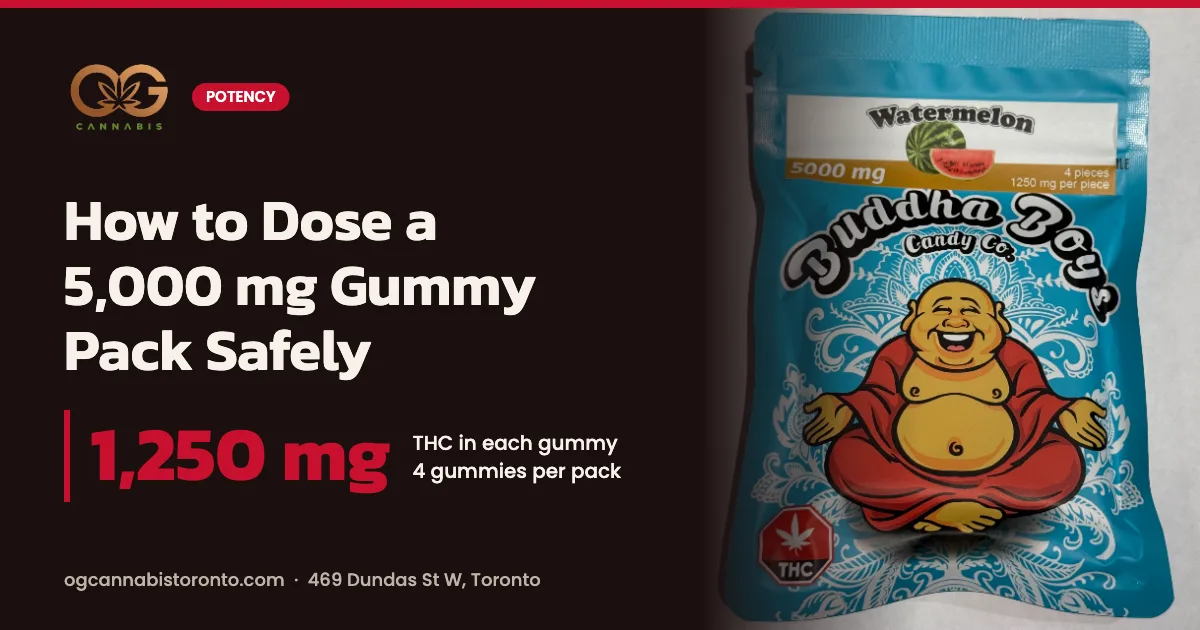
A single 1,250 mg piece from a 5,000 mg bag is 500 times a starting dose. Cutting it into precise portions is not reliable, because THC is not guaranteed to be spread evenly through an unregulated gummy. Our guide to dosing a 5,000 mg gummy safely covers portioning and its limits in detail.
Our advice: if you are new to edibles, or still learning how they hit you, do not start with a high-potency pack. A 420 mg or 500 mg pack gives you the same products at a scale where mistakes are smaller. 1,000 mg vs 5,000 mg walks through which pack size suits which person.
If you are an experienced user and understand the disclosure above, you can browse our high-potency edibles. The timeline in this guide applies to every one of them.
Driving, work and the next morning
Because edibles last so long, plan the whole day around them, not just the evening.
Driving. Health Canada’s lower-risk cannabis guidelines advise waiting at least 6 hours after consuming cannabis before driving, and note that timing “can vary based on the individual, the type or amount of cannabis product used.” With edibles, 6 hours can land you near the peak of a late-arriving dose. British Columbia’s guidance goes further: “There is no standard or safe time to wait before driving after using cannabis.” The legal side is strict too. Federal law sets blood THC offences starting at 2 ng/mL, and the maximum penalty for impaired driving is 10 years. If you ate an edible, do not drive that day.
Ontario law on vehicles. It is illegal in Ontario to consume cannabis “in any manner” in a vehicle that is being driven or could be put into motion. That wording covers edibles, not only smoking.
Work and responsibilities. The BC fact sheet says to make sure “you will not need to drive, operate machinery or be responsible for others.” That includes looking after children.
The next morning. Residual effects can last up to 24 hours. If you have an early shift, an exam or a long drive tomorrow, tonight is not an edible night.
Storage. Edibles look like ordinary sweets. Keep them locked away from children and pets, in their original labelled packaging. Hospitalizations of young Canadian children for cannabis poisoning rose sharply after edibles reached shelves, as covered in our 10 mg limit guide.
If you took too much
Call 911 right away for chest pain, a panic attack you cannot calm, or a seizure. Do not wait to see if it settles.
Ontario Poison Centre: 1-800-268-9017, open 24 hours a day, every day of the year. Call immediately, before symptoms appear, if a child or a pet has eaten any edible.
Signs of taking too much include sleepiness, confusion, dizziness, clumsiness, a fast or pounding heartbeat, paranoia and loss of contact with reality (Province of Manitoba health guidance).
If it is unpleasant but not an emergency:
- Go somewhere quiet and safe, and sit or lie down.
- Sip water. Eat something light if you can.
- Stay with someone you trust, or call someone to come over.
- Do not drive, cycle, or take anything else to “balance it out.”
- Remind yourself of the timeline. The peak passes, usually within a few hours, even though it does not feel that way.
Planning an edible night around a pickup at 469 Dundas
OG Cannabis is a pickup counter at 469 Dundas St W, one block east of Spadina, open 10 AM to 9 PM. If you order online and collect on the way home, the timeline above starts on the streetcar, not at the counter.
A few things we suggest when you pick up:
- Collect earlier than you plan to eat. If you pick up at 8:45 PM and eat at 9:30, your peak lands between about 11:30 PM and 1:30 AM. Fine for a Friday, rough before a workday.
- Do not eat it on the way home. The 505 Dundas and 510 Spadina are not where you want to be when it arrives, and consuming in public places has its own rules.
- Check the format. How a product’s pieces are split matters more than the number on the front of the bag.
Ordering takes three steps, explained in how to order. Short answers to the most common questions, including payment and ID, are on our FAQ. Everything else about the shop is on the homepage.
Edible timing questions
Why don’t I feel my edible after an hour?
An hour is often too early. Effects can take up to 2 hours to begin and up to 4 hours to peak, because THC is absorbed through the gut and processed by the liver first. A heavy meal can delay it further. Wait at least 2 hours before considering more.
Does eating before an edible make it stronger?
It can. On the dronabinol label, a high-fat meal raised total THC exposure 2.9-fold and delayed the peak by about 4 hours. That is a prescription capsule, not a gummy, but the direction holds: food tends to make an edible arrive later and last longer.
Why do edibles feel different from smoking?
Eating cannabis sends THC through the liver, which converts much more of it into 11-hydroxy-THC, an active metabolite, than smoking does. Many people describe the result as heavier and longer. Researchers still debate how much the metabolite explains, but the slower, longer timeline is well documented.
Can you still feel an edible the next day?
Yes. The Government of British Columbia says intoxication can last up to 12 hours, with residual effects up to 24 hours. Grogginess and slower reactions the next morning are common after larger doses. Avoid edibles the night before an early shift, an exam or a drive.
What should I do if my second edible kicks in on top of the first?
Go somewhere quiet, sit down, sip water and stay with someone you trust. Do not drive. The peak usually passes within a few hours. Call 911 for chest pain, seizures or severe panic, and the Ontario Poison Centre at 1-800-268-9017 for advice.
Sources
- Government of British Columbia, Edible cannabis: start low, go slow fact sheet.
- Grotenhermen F., Pharmacokinetics and pharmacodynamics of cannabinoids, Clinical Pharmacokinetics 42(4): 327–360, 2003.
- Vandrey R. et al., Pharmacokinetic profile of oral cannabis in humans, Journal of Analytical Toxicology, 2017.
- Grewal J.K. and Loh L.C., Health considerations of the legalization of cannabis edibles, CMAJ, 6 January 2020.
- Marinol (dronabinol) prescribing information, clinical pharmacology.
- Health Canada, Fact sheet about lower-risk cannabis use guidelines, modified 22 January 2020.
- Government of British Columbia, Cannabis and driving.
- Health Canada, Composition requirements for cannabis products, modified 15 July 2025.
- Government of Ontario, Where you can’t smoke or vape in Ontario.
- Ontario Poison Centre.