
Last reviewed: October 19, 2026 · OG Cannabis, 469 Dundas St W
Every legal edible you can buy in Ontario contains 10 mg of THC or less per package. That is not a shop policy, a provincial preference or a supply problem. It is a federal limit written into the Cannabis Regulations, it applies identically across the country, and the number was chosen for reasons that turn out to be more specific than most people assume.
Here is where it came from, what the evidence says about whether it works, why the industry keeps asking for it to move, and what any of that means if you are buying above it.
The short answer
- Who set it: Health Canada, under the federal Cannabis Regulations. It is not an Ontario rule.
- What it covers: 10 mg of THC per package, not per piece. Drinks count too.
- Why: edibles take up to 4 hours to peak, so people overconsume, and children mistake them for candy.
- Will it change: a 2023 petition for 100 mg was declined in July 2024.
Sources: Health Canada; CMAJ; StratCann.
First, it is not an Ontario rule
The 10 mg cap is federal. Health Canada sets it under the Cannabis Regulations, which means it binds every province equally. Ontario’s role is the retail layer: the AGCO licenses stores and the OCS runs wholesale. Neither of them chose the number and neither can change it.
The clearest proof is Quebec. When edibles were legalized federally, Quebec banned the sale of cannabis sweets, confectionery and desserts outright within its own borders. Provinces can go stricter than Ottawa. They cannot go looser. So if you have been told the limit is an Ontario thing, that is the part to let go of, because it changes where you would have to look for it to move.
One more distinction worth holding onto: the limit is per package, not per piece. A bag containing ten gummies on the legal shelf holds 10 mg in total, so each gummy carries 1 mg. That single detail explains most of the frustration consumers report with legal edibles, and it is the specific thing the industry has asked to change.
Where the 10 mg number came from
Edible cannabis became legal in Canada in October 2019. The government has been direct about how the threshold was chosen. In its formal response to a 2023 petition, it stated that the limit “draws heavily on lessons learned from, and the limits established by U.S. states that have legalized cannabis.”
Underneath that sits a pharmacological argument about how edibles behave differently from anything you smoke. Writing in the Canadian Medical Association Journal, researchers noted that effects can be delayed up to four hours after consumption and last more than eight hours overall. That gap is the whole problem. Somebody who feels nothing after forty minutes takes another dose, then another, and all three arrive at once.
The same paper is careful to say the cap does not eliminate the risk. Responses vary between individuals, and “cannabis-naive individuals” are singled out as particularly exposed. The 10 mg figure is a ceiling on how badly that sequence can go, not a guarantee against it.
There was also a warning sign from further south. After Colorado legalized edibles, its state poison control centre recorded a 70 percent increase in calls about accidental cannabis exposure in children between 2013 and 2017. Canada wrote its rules with that number already on the table.
The evidence that the cap is doing something
This is the part of the debate that usually gets skipped, and it is the strongest thing either side has.
A study led by Dr. Daniel Myran of the University of Ottawa, published in the New England Journal of Medicine, tracked hospital admissions for unintentional cannabis poisoning in children under ten across Canada from January 2015 to September 2021. It found 581 such hospitalizations, with an average patient age of three and a half years, and a 6.3-fold increase in the rate following legalization.
The useful part is the comparison built into it. Ontario, British Columbia and Alberta allowed edible sales. Quebec did not. Rates in the provinces that permitted edibles rose 7.5 times above pre-legalization levels. In Quebec the increase was 3.0 times. And once edible sales actually began in January 2020, rates in the permitting provinces climbed a further 2.9 times on top of that.
Myran’s own conclusion was that prohibiting the sale of edible cannabis products “like candies, desserts and baked goods is a key policy” for preventing these increases in young children.
Two honest limitations before anyone treats that as settled. It is observational research, so it shows an association rather than proving a chain of cause and effect, and the provinces being compared differ in more ways than their edible policy. It also counts hospital admissions, which are the severe end of a much larger number of exposures that never reach a hospital at all. None of that undoes the finding. It just means the sensible reading is “this is strong evidence about packaged products and small children,” not “this settles the potency debate.”
Read it carefully, though, because the finding is narrower than the headline. This is data about small children finding packages, not about adults misjudging their own dose. The mechanism it supports is packaging and potency per container, which is exactly what the 10 mg rule controls. It is a strong argument for the cap. It is not an argument about what a consenting adult can handle.
The case for raising it
The other side of this is serious and it comes from inside the legal industry rather than outside it.
In November 2023 a petition sponsored by Liberal MP Patrick Weiler asked the government to raise the edible limit from 10 mg to 100 mg per package. Its backers argued that a cap this low leaves licensed producers unable to compete with what is available elsewhere. Beena Goldenberg, then a CEO in the sector, put it plainly: “after three years, we are unintentionally keeping the illicit market active in this area because we are not providing equivalent legal options.”
That position had company. According to the petition’s own background material, both the Competition Bureau of Canada and the Ontario Cannabis Store had previously called for higher THC limits.
On 17 July 2024, Minister Ya’ara Saks responded. The government declined, restating that the limit exists to protect public health and safety and pointing again to the experience of U.S. states. The response noted that Health Canada would review the report of the Expert Panel on the Cannabis Act, without suggesting that a change was coming.
So the limit stands, both sides have real evidence, and the honest summary is that they are arguing about different things. One side is measuring hospital admissions among three-year-olds. The other is measuring legal market share. Both numbers are true.
Sources: Guide on composition requirements for cannabis products, Health Canada, updated 15 July 2025. Health considerations of the legalization of cannabis edibles, CMAJ. Hospitalizations for unintentional cannabis poisonings among Canadian children surged after legalization, SickKids, reporting Myran et al. in the New England Journal of Medicine. Federal government responds to edibles petition, StratCann.
What this means if you buy above 10 mg
Let’s be straightforward about the situation you are actually in.
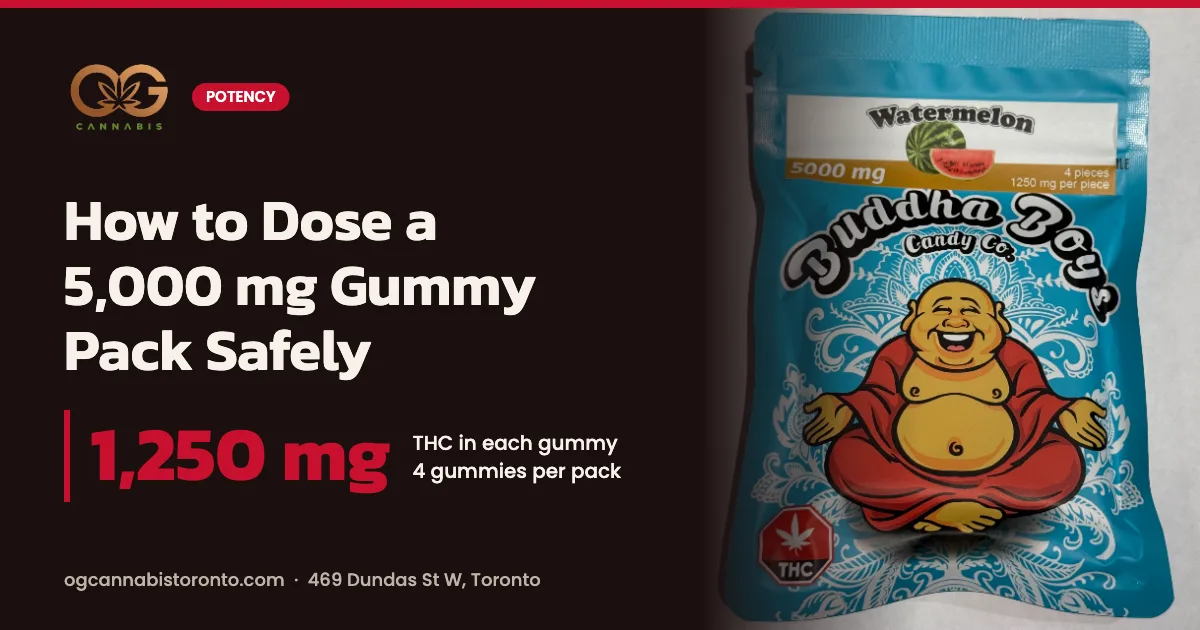
Anything containing more than 10 mg of THC per container sits outside the regulated retail system. That includes every pack on our high-potency shelf, which runs from 420 mg up to 5,000 mg. We would rather tell you that plainly than let you work it out later. It also means the dosing responsibility that the 10 mg cap was designed to carry for you now sits with you.
So carry it properly. Public health guidance for anyone who is not an experienced consumer is to start at 2.5 mg of THC or less and wait at least two hours before taking a second 2.5 mg dose. Measured against that, a 5,000 mg pack is roughly 2,000 starting doses. A 420 mg pack is about 168. These are not single servings and they were never designed to be.
The timing numbers matter as much as the milligrams. Expect 30 minutes to 2 hours before you feel anything, up to 4 hours for full effects, intoxication lasting up to 12 hours, and residual effects up to 24 hours. An edible taken at 9 PM can still be with you at breakfast. Never redose because nothing has happened after forty minutes, because forty minutes is not long enough to know.
And then there is the part the NEJM data is actually about. Store high-potency edibles locked, high up, and out of sight. A 5,000 mg bag of gummies looks exactly like confectionery, because that is what it is modelled on, and the average age in that study was three and a half. Child-resistant storage is not an optional extra with this product category. It is the condition of owning it.
Buying above the legal cap? Read the strength and dose tables on our high-dose edibles page before you order, and start smaller than you think.
What would change if the limit moved
Worth thinking about, because it may.
The petition asked for 100 mg per package rather than per serving, and that distinction is where any future change is likely to land. A 100 mg package holding ten 10 mg pieces would give consumers a familiar unit at a sensible price, without putting a bigger single dose in front of anybody. It would also leave the child-safety problem roughly where it is, which is the objection any proposal has to answer.
Health Canada’s review of the Expert Panel report is the mechanism to watch. If the number moves, expect it to arrive alongside tighter packaging requirements rather than instead of them, because the evidence base points at packaging at least as firmly as it points at potency.
The short version
If you take four things from this:
- The 10 mg cap is federal, not Ontario’s, and it is measured per package rather than per piece.
- It exists because edibles hit late and hard, and because the child-poisoning data after legalization is alarming.
- The industry’s case for raising it to 100 mg is real, was formally made in 2023, and was formally declined in July 2024.
- Above 10 mg per container you are outside the regulated system, which means the dosing discipline the rule was built to provide is now yours to supply.
Common questions
Is the 10 mg limit per gummy or per package?
Per package. A legal bag of ten gummies contains 10 mg of THC in total, so each piece carries about 1 mg. This is the detail most consumers find surprising, and it is the specific thing the 2023 petition asked the government to change.
Did Ontario set the 10 mg limit?
No. It is a federal limit under the Cannabis Regulations, administered by Health Canada, and it applies in every province. Ontario runs retail through the AGCO and the OCS but did not choose the number and cannot raise it.
Why did Quebec ban edibles entirely?
Provinces may impose rules stricter than the federal framework, and Quebec chose to prohibit the sale of cannabis sweets, confectionery and desserts. That decision created the comparison group used in the NEJM research, where Quebec saw a 3.0-fold rise in child poisoning hospitalizations against 7.5-fold elsewhere.
How many legal packages equal one high-dose pack?
One hundred. A 1,000 mg pack holds the same total THC as one hundred legal 10 mg packages, and a 5,000 mg pack holds as much as five hundred. That arithmetic is the clearest way to understand what you are holding when you buy above the cap.
Does the 10 mg limit apply to cannabis drinks as well?
Yes. Cannabis beverages are regulated as edible cannabis, so the same limit of 10 mg of THC per immediate container applies to a can or bottle exactly as it does to a bag of gummies. That is why legal cannabis drinks are sold as single low-dose servings.
Will the limit be raised to 100 mg?
Not at present. A petition sponsored by MP Patrick Weiler requested exactly that in November 2023, and the federal government declined on 17 July 2024, citing public health and the experience of U.S. states. Health Canada’s review of the Expert Panel report remains the process to watch.
Last reviewed October 19, 2026. General information, not medical or legal advice. You must be 19 or older to purchase cannabis in Ontario. Keep all cannabis products locked and out of reach of children and pets.
Keep reading: how to dose a 5,000 mg gummy pack safely, 1,000 mg vs 5,000 mg edibles, and how long edibles take to kick in. Every strength we carry is on our high-dose edibles page.