Last reviewed: October 20, 2026 · OG Cannabis, 469 Dundas St W
AAAA weed is flower sold as the top grade on a four-letter scale that runs from A at the bottom to AAAA at the top. The scale is informal. No Canadian regulator defines it, no lab assigns it, and two shops can put the same four letters on very different flower.
That does not make the letters useless. It means you need to know what they can and cannot tell you. This post covers where the grades came from, what a grader is supposed to be judging, and what AA to AAAA+ actually look like on our own shelf, with the listed THC and the price for every tier. At the end there is a section on LSO, a label you will see on some of our top-tier flower that describes how it was grown rather than how it was graded.
The short answer
- AAAA weed: the top grade on an informal A to AAAA letter scale, often called “quads”.
- Who sets it: nobody official. Letter grades are not a regulated term in Canada.
- What it should reflect: bud structure, trichome coverage, aroma, burn and freshness.
- What it does not guarantee: more THC. On our shelf, AA listings average higher listed THC than AAA.
- LSO: Living Soil Organic, a growing method, not a grade.
Sources: StratCann; our product listings, October 20, 2026.
Where the AA to AAAA weed scale comes from
The letters predate legal cannabis in Canada. Marty Wig, who says he has been reviewing cannabis since 2003, described the old system in a 2022 column for StratCann. Good weed was AAAA. Decent weed was AAA. Discount weed was AA, and bunk weed was A. Most of what people actually bought sat in the middle, which he calls “dubs and trips”. In his words, “Rarely did anything ever reach the glory of quad status.”
That is where “quads” comes from. It is shorthand for AAAA, the top of the scale. If someone asks for quads, they mean AAAA weed.
Licensed cannabis took a different path. Products sold through the legal system carry a THC percentage on the label, not a letter. Letter grades stayed with the unregulated market, and they are still not a regulated term in Canada. That includes the letters on our shelf. No regulator sets them or checks them, so read every grade, ours included, as the seller’s own judgment.
Many shops, ours included, also add a fifth tier above AAAA, written AAAA+. There is no fixed rule for what earns the plus either.
What AAAA weed is supposed to look, smell and burn like
Because nobody standardised the scale, there is no official checklist for AAAA weed. The closest thing is how experienced reviewers say they judge flower. Wig built his own 100-point rating guide and treats a score of 80 or more as AAAA. The things he looks at are a fair summary of what any grade is trying to capture.
- Structure and bag appeal. Dense, well-formed buds with good colour.
- Trichome coverage. Buds visibly coated in resin that feel slightly sticky rather than dry.
- Aroma. He smells the flower before and after opening the jar. A fresh, distinct smell is a good sign. A flat, hay-like smell is a bad one.
- Burn and ash. An even burn, with light-coloured ash that holds together.
- Freshness. He checks the package date.
Notice what is missing from that list. THC percentage is not on it. A grade is supposed to be a judgment about how well the flower was grown and handled. It is not a potency rating, and our own numbers show why the two should not be confused.
What AA to AAAA+ look like on our shelf
We pulled every loose flower listing on our site on October 20, 2026, 51 in all, and grouped them by the grade they are listed under. The THC figures are the numbers stated on each product page. Two listings had no THC figure and are left out of the ranges and averages.
| Grade | Listings | Listed THC range | Average listed THC |
|---|---|---|---|
| A | 3 | 19% to 20% | 19.5% |
| AA | 19 | 17% to 25% | 22.4% |
| AAA | 10 | 19% to 25% | 21.5% |
| AAAA | 6 | 24% to 27% | 25.2% |
| AAAA+ | 13 | 23% to 34% | 28.3% |
Two things stand out.
First, the bottom of the ladder does not sort by THC at all. Our AA listings average a higher listed THC than our AAA listings, and both top out at 25%. If grades were a potency scale, that could not happen.
Second, the tiers overlap at the top too. Even AAAA weed is not a THC guarantee. Our lowest AAAA+ listing, Strawberry Grail, is listed at 23%, below several AA strains at 25%. Our highest, Pink Dragon Breath, is listed at 34%. Pink strains make up a big share of that top tier, and we cover them in our Pink Kush strain guide.
Read the other way, the table does show a trend. AAAA weed and AAAA+ listings run higher on average, 25.2% and 28.3%, than anything below them. Higher grades and higher THC tend to travel together. They are just not the same thing, and a single strain can break the pattern in either direction.
Want to compare the tiers yourself? Every grade has its own section in our flower range, from AA ounce deals up to the AAAA shelf.
What AAAA weed costs compared with lower grades
Price follows grade more closely than THC does. These are single listings from each tier, chosen as typical examples, with prices as of October 20, 2026. Individual strains vary, so check the product page before you order.
| Grade | Example listing | 1 g | 3.5 g | 28 g | Per gram at 28 g |
|---|---|---|---|---|---|
| A | Tropical Sunrise | $5 | $15 | $100 | $3.57 |
| AA | Berry Cake | $5 | $15 | $100 | $3.57 |
| AAA | Pure Michigan | $8 | $25 | $150 | $5.36 |
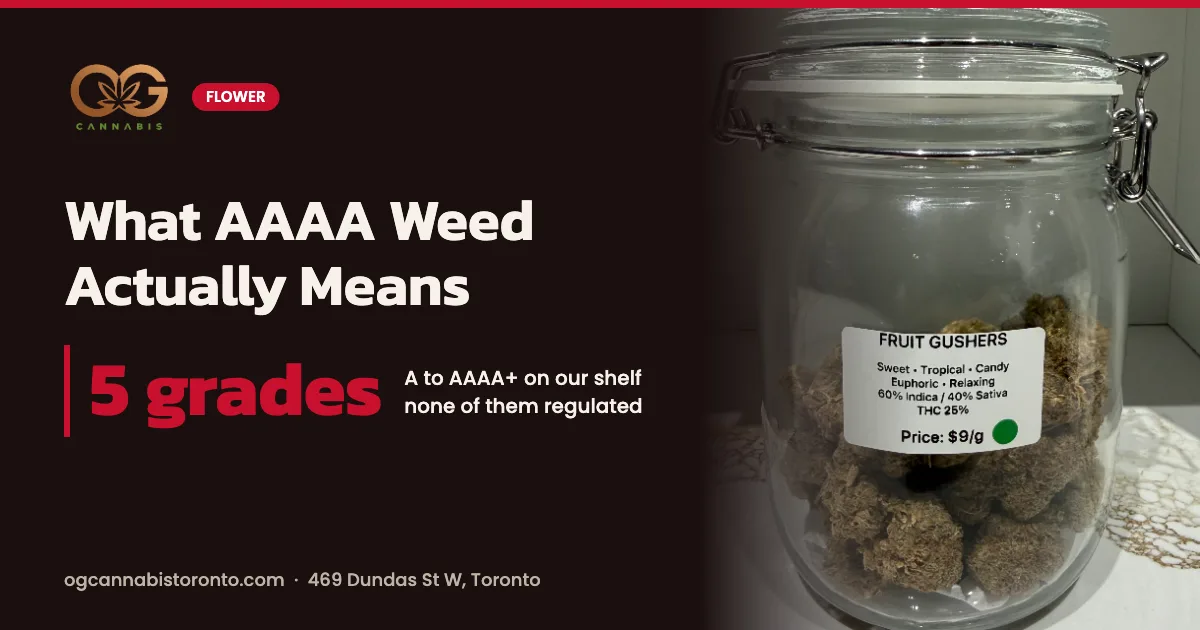
| AAAA | Fruit Gushers | $9 | $28 | $170 | $6.07 |
| AAAA+ | Bruce Banner | $10 | $30 | $180 | $6.43 |
The biggest jump on our ladder is between AA and AAA: $3 more per gram, or $50 more per ounce. Above that, the steps get small. AAAA costs $1 a gram more than AAA, and AAAA+ costs $1 a gram more than AAAA, or $10 more per ounce.
If you are deciding whether to trade up, that is the useful part. Going from AA to AAA is the expensive step. Going from AAAA to AAAA+ costs very little, so if you already buy AAAA weed, the top tier is cheap to try.
There is one more option at the bottom. Our AA ounce deal listings sell 14 g for $25, about $1.79 a gram, when in stock. They are listed as AA, with listed THC between 17% and 25%.
Why a THC number is not a quality score either
If grades are subjective, it is tempting to skip them and shop by THC instead. The research says to be careful with that too.
Flower THC labels are often wrong, even in regulated markets. A 2025 study in Scientific Reports had 178 flower products from Colorado dispensaries tested independently. About 44% fell outside the state’s allowed 15% margin, and 54 of them overstated THC. One product labelled 24% tested at 16%. Concentrates, by comparison, were labelled accurately 96% of the time.
Canada has seen the same problem. In 2023 a licensed lab in Kelowna tested 46 legal flower products from 21 producers and found that every one had less THC than its label claimed, by 9% to 48%. That testing was not peer reviewed and the products were not named, so treat it as a warning sign rather than a final verdict. MJBizDaily reported at the time that Health Canada allows a set margin for extracts and edibles but sets no variability limit for dried flower, because THC varies from plant to plant and batch to batch.
Then there is the question of whether THC predicts a good experience at all. A 2022 study in Psychoactives followed 276 volunteers through more than 3,000 sessions with commercial flower. The researchers concluded that “pleasant aroma is predictive of pleasant subjective effects”, while THC potency was not. The study was observational, so it shows a link, not cause and effect. It does line up with the old grading checklist, which puts smell near the top and potency nowhere.
How to use grades when you buy
Put together, here is a sensible way to read a grade, ours or anyone else’s.
- Treat the grade as the seller’s judgment, not a measurement. It tells you where a shop places a strain on its own shelf. It does not carry over from one shop to the next.
- Compare strains within the same shop. A shop’s AAA and AAAA weed should differ in ways you can see and smell, even if its grades would not match another store’s.
- Check the listed THC separately, and treat it as approximate. Given the label research above, a few percentage points either way is normal.
- Let your nose decide between close options. The aroma research and the old graders agree on that much.
- Try small before you buy big. On our ladder, 3.5 g of AAAA+ costs $30. That is a cheap way to find out whether the top tier is worth $80 more per ounce than AA to you.
- If you are new, start low, whatever the grade. Health Canada’s lower-risk guidance suggests new users start with one or two puffs of a product at 10% THC or less. Every flower listing on our shelf is above that, so go slowly.
What LSO means
LSO stands for Living Soil Organic. You will see it in the names of two strains on our shelf, LSO Wedding Cake and LSO Platinum Punch, both in our AAAA+ tier and listed at 30% and 28% THC.
Our LSO Wedding Cake listing describes the method as growing in soil where beneficial microbes and organic nutrients feed the plant. Leafly describes living soil the same way: soil “alive with symbiotic microbes and fungi”, fed with compost and compost teas rather than bottled nutrients. Many growers run it as a no-till system, keeping the same beds for cycle after cycle and topping them up with amendments instead of starting fresh.
The case for LSO, as its growers make it, is flavour. Living soil practitioners say the more natural root zone produces a more varied terpene profile than hydroponic growing.
The case against overselling it is evidence. A research roundup from Cannigma notes that blinded taste tests comparing living soil and conventional cannabis at scale have not been done, and puts it plainly: “Claiming definitively superior quality goes beyond what the current science supports.”
So LSO tells you how a strain was grown. It is not a grade, and it is not a promise. On our shelf the two LSO strains cost the same as every other AAAA+ listing, $10 a gram or $180 an ounce. If you want to judge the method yourself, compare an LSO strain with a non-LSO AAAA+ strain of a similar type, side by side.
Sources: The Good Weed Board, part one, Marty Wig, StratCann, July 30, 2022. Accuracy of labelled THC potency across flower and concentrate cannabis products, Giordano et al., Scientific Reports, 2025. Canadian cannabis industry reckons with inflated THC label claims, MJBizDaily, March 21, 2023. The Nose Knows: Aroma, but Not THC Mediates the Subjective Effects of Smoked and Vaporized Cannabis Flower, Plumb et al., Psychoactives, 2022. Cannabis: lower your risks, Health Canada. What is living soil?, Leafly. Living soil cannabis cultivation, Cannigma.
The short version
- AAAA weed is the top grade on an informal A to AAAA scale. “Quads” means the same thing.
- No regulator defines letter grades in Canada, ours included. They are each seller’s own judgment.
- Grades are meant to reflect structure, trichomes, aroma, burn and freshness. THC is not part of the checklist.
- On our shelf, AA averages 22.4% listed THC and AAA 21.5%. AAAA and AAAA+ run higher, at 25.2% and 28.3%, but the tiers overlap.
- Price tracks grade more than THC does: $3.57 a gram for an AA ounce, $6.43 for AAAA+.
- LSO means Living Soil Organic. It describes how a strain was grown, not its grade.
Common questions
What does AAAA mean in weed?
AAAA weed is flower placed in the top grade of an informal four-letter scale, from A at the bottom to AAAA at the top. It is meant to signal the best-looking, best-smelling, best-burning flower a seller has. The scale is not regulated, so each shop applies it in its own way.
Is AAAA weed stronger than AAA?
Often, but not reliably. On our shelf, AAAA listings average 25.2% listed THC against 21.5% for AAA, yet our AA listings average higher THC than AAA. A grade is a quality judgment, not a potency rating, so check the listed THC separately.
What is AAAA+ weed?
AAAA+ is a fifth tier some shops add above AAAA for their top flower. There is no standard for what earns the plus. On our shelf, AAAA+ listings run from 23% to 34% listed THC and cost $10 a gram, $1 more than AAAA.
What does quads mean?
Quads is slang for AAAA, the top letter grade. Reviewers talk about flower reaching “quad status” when it earns the highest tier.
What does LSO stand for in weed?
LSO stands for Living Soil Organic, a growing method that uses microbe-rich organic soil instead of bottled nutrients, often reused across many grow cycles. It describes how the plant was grown. It is not a grade.
Are weed grades regulated in Canada?
No. Legal cannabis is labelled with a THC percentage, not a letter grade. AA, AAA and AAAA come from the unregulated market, and no government body defines or checks them.
Last reviewed October 20, 2026. Grades, prices and listed THC are taken from our product listings on October 20, 2026 and change often. General information, not medical advice. You must be 19 or older to purchase cannabis in Ontario.
Keep reading: our Pink Kush strain guide, infused pre-rolls explained, and how long edibles take to kick in.